Menu directory status & updates copyrights help
This webPage is best viewed in a window ~950 pixels wide * 1080 high (1/2 of an HDMI screen). 15May2025 initial [note, draft]s.
Almost all images (other than a few of my own) and most of the information is copyright www.MagicalEgypt.com

Magical Egypt: Season 1 Symbolist perspective

Bill Howell: I have provided point-form commentary from the 2001 "Magical Egypt: a symbolist tour" 6*DVD series below, together with my review notes, which are hugely [incomplete, erroneous, biased]. I am very weak in the areas of [magic, mystery, etc]. My comments are clearly indicated by orange background, sometimes starting with "Howell: ". Hopefully these will not [de, dis]-tract the reader from the real messages of John Anthony West and his contributors. A separate webPage shows a full collection of my comments for this video series.

Unlike my webPage on Jacobovici's film "Genesis proofs", I have not provided the complete wording from all 6 DVDs of "Magical Egypt: Season 1 Symbolist perspective". I have ONLY done DVD2 and DVD3 in detail, with images, and have stopped my work for now.

To view full-size images: in your browser, right-click on an image, then select "view in a different tab".

Copyright, credits : see the bottom of this webPage for more details :

Table of Contents


DVD1: the invisible science

I somehow completely ruined the DVD physically, and cannot go over this "first pass" note-taking, or extract images, at least until I get a new DVD.

1. Anthony West: the mystery schools

Egypt:

2. Schwaller de Lubicz: at Luxor found the key to all of the temples

Schwaller de Lubicz: How old is the Spinx?

3. sacred geometry- fractals


4. Michael Schneider: fractals are basic to nature, provide balance with growth

Michael Steinbremer ?date? "Mathematical Archetypes: A beginner's quick guide to constructing the universe" ?publications info" JA West refers to: Alexander Badawy ?date? "Ancient Egyptian architectual design: A study of the harmic system". see DVD3 chapter 1. Thomas Brophy: Nabla Playa origin Map (Orion or ?) Nubian desert megaglitic arrangement (below) A fun tidbit is this speculation-beyond-specifically-stated by Velikovsky about the Karnac temple "Howell 120513 Ark of the Covenant.pdf".

5. Thomas Brophy: Origin Map (Orion or ?) Nubian desert megaglitic arrangement

Thomas G. Brophy ?date? "The Origin Map: discovery of a [prehistoric, megalithic, astrophysical map and sculpture or the universe"
forward : Robert M. Schoch
afterword: John Anthony West

For Naba Playa details in DVD3, see Thomas Brophy: Nabla Playa origin Map

6. the house of life


7. Anthony West: Luxor's 4D architecture: evolving over centuries?


DVD2: the old kingdom, and the still older kingdom


01:42 JA West: This DVD focuses on the period 2,200-2,700 BC, showing evidence suggesting, controversially, that Egyptian dynasties tens of thousands of years (>=36,000 BC).
Periods of :

Osirium temple: Egyptian stone relief wall [document, list, name]s ~34-36kyBC of pharaohs.

2. the old kingdom and the still older kingdom

This chapter is narrated by John Anthony West (JA West).
04:32 2,500 BC has been the Egyptologists' accepted age of the Sphinx, a product of the 4th dynasty.

The above items are from the Neolitic period, not Old Kingdom Egypt, and not even from Egypt itself. They serve as illustrations to contrast with the first known Old Kingdom, and even pre-Old Kindom, items from Egypt. As you can see, there is a world of difference.

05:40 Hard to believe that Egypt at 2,700 BC was a civilisation barely emerging from primitivism. 5,000 BC neolithic civilisation producing crude pottery, supposedly just a few centuries before [Picara stepped pyramid, Sphinx]. There is a contradiction and a problem here, sometimes acknowledged, rarely addressed by the academic fraternity.

04:43 2,700BC ?Picaro stepped pyramid went up 10 miles South of Giza. Built by King ?Zhosa? of the 3rd dynasty, according to a plan by Imhotep?, legendary [sage, keeper of ??, mathematician, astronomer, prophet].

07:08 Perhaps more astonishing is the fact that Egypt was at its height, early in the Old Kingdom. Nothing produced by Egypt thereafter surpassed, and seldom equalled, the masterpieces of the Old Kingdom.

2. Cairo museum- bits and pieces of a lost civilisation

10:08 In the Cairo museum we find bits and pieces of a lost civilisation. We find for example little stone bowls carved out of some of the hardest stone [porphyry, granite, green schist, dialite], with narrow necks and hollowed in the center. We could not today produce these stone bowls, yet they date to early Egypt, pre-dynastic even. The Egyptians were only supposed to have copper tools to word with. We think they may be heirlooms handed down over generations.

15:00 stone statue, Horus, as as principle of salvation hidded at back of head. Similarly into the consciousness of the king. A [divinised, exalted, self-realized] human being.

3. Robert Schoch, JA West: how old is the Sphinx?

22:37 ?narrator?: Perhaps the most visible example of an advanced civilisation in Egyptian pre-history is the Great Sphinx itself. ?The head was re-built some time after initial construction?

23:07 RAS de Lubicz : "... A great civilisation must have preceded the vast mouvement ?of warmth? in the path of Egypt, which leads us to assume that the Sphinx already existed ... the distinctive lionine? body, except for the head, shows indisputable signs of aquatic erosion. .."
23:45 JA West: "... It all began, actually, from a single line from one of his ancillary books ... the ancient Egyptian knowlege that their civilisation goes way back before dynastic Egypt. ..."
I'm basically doing what sleeman did with Troy (see above) : 25:44 JA West: "Just by taking them (ancient Egyptians) literally, you end up with 34-36kyBC ... water weatahering is what clicked with me ... there hasn't been rain in the Sahara desert here for at least 10ky. ...". 26:53 JA West: engaged Boston University geologist Robert Schoch
27:32 Robert Schoch "... This is clear evidence to me as a geologist, that this erosional feature we see what is caused by rain beating down on the rock. ..."

28:16 JA West: "... I take the most radical view, which seems to me is most plausible, and again it is following the Egytians themselves, when they are talking about 34-36ky I think that is what it is. ... Egyptians talked about the age of Aquarius ... knowledge about precession goes back into deep antiquity. Last age of Leo was 10-10.5kyBC, but that was a period of chaos with the break-up of the last ice age, not monument building. If Sphinx is looking at its own image in the sky as the Sun rises at the equinox, had to be the previous age change 26,000 years before, or 36kyBC, which corresponds to the Egyptian text themselves.
30:50 JA West: even though it looks outrageous to an academic, for me, that is the most plausible of the scenarios.
21:10 narrator: The Spinx, and its marker Leo, demonstrate a knowlege of advanced celestial mechanics, and the observation of phenomenaq spanning tens of thousands of years.

4. the Red pyramid: built on top of a far more [ancient, weathered] construction


31:55 JA West: Red pyramid of ?Adaua?, build by father of Khofu, ?Nefaru? 2,500-2,600 BC, older blocks are completely protected by new pyramid above. Could not have weathered after Red pyramid built, so must have been exposed for a long time, and has to be much older than the Red pyramid built on top of it.

5. the Valley temple: [huge, simple] blocks, only similar structure is Oserion temple

36:39 JA West: Valley temple, huge granite blocks applied to a limestone core. This could not be done in one, simple stage ( like the construction under the Red pyramid). the core was build in already-weathered limestone at a much later date, probably by the pharaoh Kofra
39:01 Schoch: 4,500 years ago ( 2,500 BC?), describes other materials like alabaster etc
41:25 West: chants "ooohm" to show sound resonance even without a roof!

6. Oserion temple: [long predates, physically close to] Sphinx

Oserion temple- I didn't seem to vidCam capture this chapter, just the Valley Temple??
Actually, I can't identify when discussions shift to from the Valley temple to the Osereion temple...

Going back to theme of the beginning of the Egyptian civilisation: Oserion temple:

DVD3 Descent

??:?? West: perhaps we have misread the entire process of history, and we have not gone in a [straight, linear] line, from ancient primitive beginnings to us.
02:04 West: Ancient Egypt unquestionably was at its beginning, and went on a downhill path through the long 3,000 years of its history. That decline certainly extended through the Roman Empire and arguably down to the present day.

04:08 "... The ancients thought that they could only go to heaven on the two solisticial days ..."
Howell: speakers also mention equinoxes, go on to millenial basis.. but are not clear about [precession, obliquity, eccentricity].
04:03 "... an inevitable prelude to a new tilting, a new world age ..."
  • Giorgio de Santiliana, Hertha von Dechend 1968 "Hamlet's Mill"
  • ??:?? West: says this book was the start of the West's understanding of ancient astrology?-astronomy-archaeology.


  • 1. Thomas Brophy: Nabla Playa origin Map, Nubian desert mega-lithic arrangement, Orion constellation

    05:08 "... The Nabla Playa complex is located 100 km west of Abo Simpel in the Nubian Desert. It was first discovered in 1974 by a team led by Professor of Anthropology Fred Wendorf. This team determined that the stone structures, the oldest yet found, were a center of ritual gathering dating from as early as 11,000 years ago. ..."

    06:14 Thomas G. Brophy ?date? "The Origin Map: discovery of a [prehistoric, megalithic, astrophysical map and sculpture or the universe", forward : Robert M. Schoch, afterword: John Anthony West
    notice the [for, after]-word to Brophy's book by [JA West, R Schoch], who [created, augment]ed this DVD series

    06:23 West: It's becoming clear in the new sub-discipline of archaeo-astronomy that sophisticated astronomical knowledge existed in very, very ancient times. Beginning with a book called "Hamlet's Mill" published in 1968 but MIT historian-scientist Giorgio de Santiliana, Hertha von Dechend. It was found that extremely sophisticated astronomy was coded into the mythologies and legends of very ancient peoples. Perhaps most significant is that the ancients recognized, and employed, what is called the precession of the equinoxes in their [myth, legend, construction]s. eg 4,900 BC matches

    12:45 Brophy: The three side stones are showing [position, angle]s at the meridian at the minimum of the 26,000 year precessional cycle.
    ??:?? Brophy: The distance of the stone collections from the central hub, are proportional to their stars asto-distances from Earth to within the standard error of measurements today.
    That the distance of the stone collections from the central hub are proportional to their stars asto-distances from Earth, is stunning to me. Parallax is best used to determine distances to star that are "somewhat close to Earth (<?? light-years), whereas the very problematic red-shift is used for longer-distance stars and also for galaxies: Assuming that the ancients used parallax, this was was an unbelievable accomplishment, complicated by movements such as [Chandler wobble of Earth (months period), sun barycenter, [precession, obliquity, eccentricity], the solar system's movement in the Milky Way]? I assume that very accurate records over perhaps a precessional cycle or two might have been required? Maybe not?
    Ancient estimates of the distances to nearby stars (Brophy in this video), reminds me of ?oops - forgot while I was writing?.


    2. Robert Dunlap: La Braya tar pits, catastrophic event mass extinctions

    27:05 Robert Dunlap: La Braya tar pits perfect preservation of animals at end of the Pleistocene era (10,800-12,000 yrBP).
    27:16 Dunlap: great collection of animals that went extinct
    29:22 Dunlap: in the geologic record, there is evidence of 8 major ice ages

    I seem to remember 10 major ice ages over last 1Myr (not 8, see Howell 2007 Glaciation models over the last 1 million years), smaller ones going back ~6Myr (Howell - Glaciation models for the last 6 million years.pdf). The discrepancy may make sense, as one can interpret two of the 10 as being one extended glaciation, and perhaps in the decade preceding the date (2001) of the Magical Egypt series, the [data, interpretations] were different. But, its clear that I have let a [model, concept] dominate my thinking on this point, rather than the actual data. <oops>

    30:40 Dunlap: around the world there is always a story about a great [flood, deluge], eg Australian aboriginees, backed by geological evidence, Incas
    31:31 Dunlap: [asteroid, comet] is another theory for cause, most famous is dinosaur extinction 64Myr ago at KT boundary. backed by [iridium, micro-tectites, shock-quartz crystals] Walter Alvarez UofCalBerkly, Frank ?Afaro? Lawrence Livermore, Jack Wolf pin-pointed month of June occurrence with water lilly flowers
    34:17 Dunlap: Jurassic-Triassic boundary, Permian-Triassic boundary 96% of species went extinct within a one day period

    3. Catastrophe

    35:00 West: Imagine this scenario, an ice age that holds Earth in its grip for thousands of years. Yet there is in place, perhaps globally, certainly in Egypt, an advanced and sophisticated civilisation. It is this that would give rise to Plato's story of Atlantis, and to similar accounts of [legend, story]s around the world.
    36:04 West: But a few human beings manage to survive, make their way to safe ground, carrying with them as much of their knowledge as they possess. They manage to pass this knowledge down perhaps for thousands of years, even though they lived in what we might call primitive conditions. ... even these societies are currently being reconsidered and systematically upgraded by today's archaeologists. The dates of civilisation keep being pushed backwards even in academic circles. An appreciation of the knowledge available to the ancient cultures goes through an equally systematic transformation.
    36:34 West: Then around the same time in [tradition, myth]s, around 3,000-4,000 BC sophisticated civilisations arise simultaneously in [India, China, Mesopotamia, Egypt, central America].
    36:49 West: In Egypt it takes but a few generations to develop from [crude artwork, simple mud-brick building]. Heiroglyphs arise to a level and perfection that will never be surpassed, and seldom equaled anywhere else on Earth for centuries to come.

    misplaced? :
    ??:?? At the very beginning, there was a huge jump in [math, science, ?mystery, consciousness?]. Going from [crude, simple] archaeological findings to the beginning of the civilisation could not have developed within a 200 year span. Earlier civilisations:
    Other food for thought on catastophes: There are jillions of references that describe history and catastrophes in a very different, and useful, light. Here are just a few that I've run across:

    4. Walter Cruttendon: cycles of the Indian Yugas

    38:35 narrator: The apparent "reversed evolution" in ancient Egypt is a contradiction of the Western model of linear progress culminating in modern man.

    38:45 narrator: The Indians system of the yugas explains a vast cosmic cycle, which like the changes of the seasons on a [grand, metaphysical] scale causes mankind ...?to periodically fall off his perch?... to awaken on the return of the next grand cycle.

    39:33 Walter Cruttendon: The Yugas are a long-term chronology system of the ancient Indian culture.
    39:57 Cruttendon: patterns of human behaviour over long periods of time: depending on celestial phenomena.
    Howell: Cruttendon's cycle lengths do NOT agree with [wikipedia, popularvedicscience.com]!! I guess there may be a "smaller scale repeat" of the yugas, including one 24 ky long for all 4 yugas? However, the [Iron, Bronze, Silver, Gold] = [Kali, Dvapara, Treta, Satya] ages is consistent (albeit poorly stated for clarity). Overall, I get the feeling he is [wave arm, yap]-type guy

    Here are descriptions of cycle times from Hari Dasa "the 4 Yugas, the cosmic ages of Satya, Treta, Dvapara, and Kali yuga", last update December 11, 2023. see also https://en.wikipedia.org/wiki/Kali_Yuga. I'm not impressed with Cruttendon's [stumble, fumble]ing through the subject, although it fits right in with many others from the humanities etc.
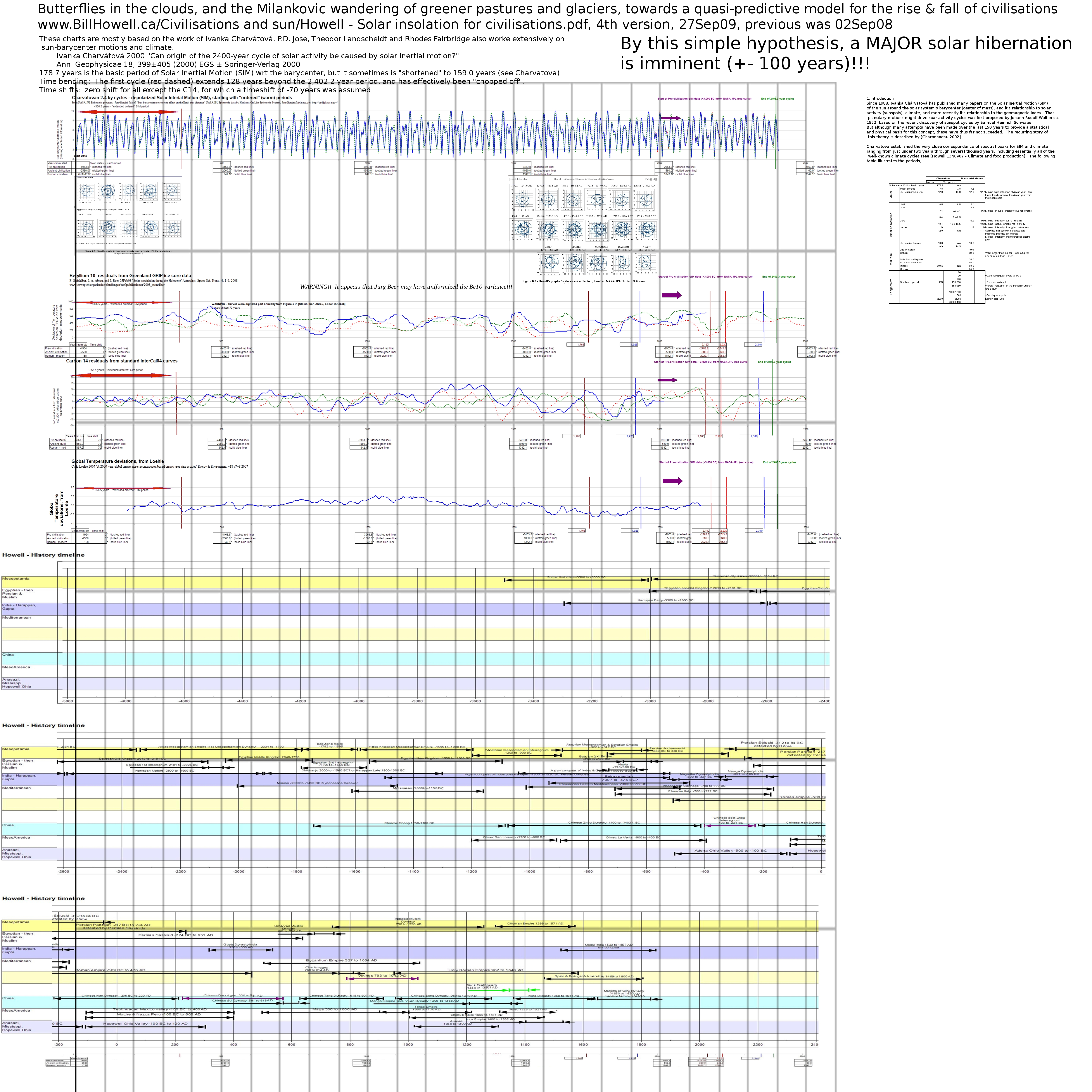
    Howell: again getting back to Ivanka Charvatova to provide another view of cycles <=2,400 years. The table above is in the pdf Howell Aug08 - Charvatovas hypothesis & Isotopic solar proxies.pdf. It does a great job of explaining many [important, well-established] cycles. (again, click-right to view a larger image)
    Howell: I want to create a table of cycles from many ancient mythologies [Mayan, Egyptian, Judaism, Mulsim, etc]... maybe some years from now???

    5. Climbing out of the Dark Ages

    ??:?? narrator: can't hear wording (sound quality - I set recording too low?) somenting about catastrophes
    02:00 West: modern day academics discuss Egypt in terms of their beliefs: the Egyptians believed this, and the Egyptians believed that. Supposing, in their arrogance, that they know better: "they believe (ancient Egyptians), we know (modern academics)". But suppose it's the oother way around? Suppose the Egyptians actually knew immortality, and that our academic community, locked in their fashionable beliefs, believe?
    02:25 Howell: DVD3-2 can't make out words


    DVD4: Luxor, The Temple [of, is] Man

    01:02 narrator: Do the temples' [religion, art, science, philosophy] express a unity of man? Are they interactive tools that relay ancient wisdom?
    01:22 Recent discoveries are beginning to suggest that the temples were not just the location of teachings, they WERE the teachers.

    Howell: Refering again Velikovsky's includion of a petroglyph from the Karnac temple "Howell 120513 Ark of the Covenant.pdf", rather pitiful war gains of Ramses the 2nd are documented. Was the Arc of the Covenant erased?


    1. The temple is the teach[er, ing]

    01:40 narrator: ...some now call it (Luxor) the "Temple of Man"
    Howell: was it Lubicz who named Luxor temple the "Temple of Man?
    01:46 narrator: Luxor temple- built over a period of 5 centuries, had it been planned entirely in advance?
    02:04 narrator: Is it possible that the ancient Egyptians had a knowledge of human reproduction at the microscopic level?

    02:52 West: [Luxor] temple is a puzzle, an expression of artistic genius, unequalled in all of time. And yet it originated from the earliest recorded history.
    03:11 West: Unorthodox pieces of mass communication
    03:25 West: everpresent blueprint to elevated states of human creativity
    03:30 West: The temples are not here as just repositories, they are timeless teachers.


    neta images in temples are NOT gods. They represent :
    the neta are not gods! neta like [Set, ], gods like [Amun, Amon, Ra?, ??]
    Howell: That's radically different from what is always said by the experts, and therefore is worthy of attention.

    Starting from Dwardu Cardona's concept "Table: Gods are Planets, Planets are Gods", based on Dwardu Cardona and his books inluding "Red Star". I continue to add to the table of [God, Planet]s slowly over time as I find more. Here :
    Hawthor = goddess mother. Early images human face, bull [ear, horn]s. Later images worn inverted vase?

    2. R.A. Schwaller de Lubicz - the key to understanding the Egyptian temples


    3. Inside the Luxar temple


    4. Valley temple?: pre-Sphinx unique [layout, construction], rounded joints and oral resonance


    5. The seed


    6. Third eye


    DVD5: Navigating the after-life! What to do in the Duat.


    1. Introduction

    Temples - each dedicated to a neta (not god). eg [Amon, Osiris, Set, Isis]

    2. Valley of the Kings

    Luxor, the Temple of Man, has keys for decoding all of the temples. We now have these keys thanks to German [alchemist, anthropologist, ???] R.A. Schwaller de Lubicz[s]. He studied the Luxor temple 1936-51. Various stages of the Luxor temple: Amon: stone relief giant penis, illustration of a sperm cell. 8 initial divisions of fertilised egg


    3. Tomb of Tutmosis III


    4. Mummification


    5. the Pineal Gateway

    snake symbolism of consciousness:

    6. Lucid dreaming


    7. the Materia Prima


    DVD6: Legacy


    1. the knowledge is alive

    memes: basic unit of cultural evolution
    Toth - teaching of language
    Karnac temple: secrets of magic
    data of Nile river flooding
    [intelligence, ?consciousness?] cycles Kemet = Egptians called own land = black land. Also basis of word "alchemy"

    2. the materia prima


    3. cyclical fertility


    4. stellar resonance


    5. the stone


    6. vessel across the dust


    7. the cradle of magic


    8. a legacy of initiation


    9. solve et coagulate


    Howell: overall [impression, question]s


    Copyright, credits for the film series

    "Magical Egypt: a symbolist tour", 6*DVD series, 2001
    A Chance Gardiner / Cydonia, Inc. Production
    Cydonia motion graphics

    credits below taken from DVD 6

    narration Derek Partridge
    original score Geraint Hughes
    starring John Anthony West, Lon Milo Duquette
    written & produced by Chance Gardiner
    script consulting Derek Partridge
    3D modelling Law Gardiner
    business development Vanese McNeil, Mark Sussman

    Special thanks to: Special Special Thanks to:
    Venese McNeill
    Mark Sussman
    Law Gardiner
    Cabel Adams
    Brian Walker
    Scott Leslie
    Matt Steinauer
    Todd Kesselman
    Rachel Edlich
    Melinda Thorne
    Scott Isdaner
    Peter Bieler
    Loraine Grover
    Liz Loeper
    Derek Partridge
    John Anthony West
    Philip La Porta
    Rick Strassman
    Lon Milo Duquette
    Robert Dunlap
    Walter Cruttenden
    Thomas Brophy
    Loren Cabrera
    Ramona Cloutier-Rudolph
    Clive Middleton
    Stephanie Jakubiak
    Michel S. Schneider